
Even as Donald Trump blasts Anthropic PBC’s Dario Amodei over his call to hit the brakes on AI development, the two agree on the need to prevent China from catching the US. But doing that remains difficult in practice.
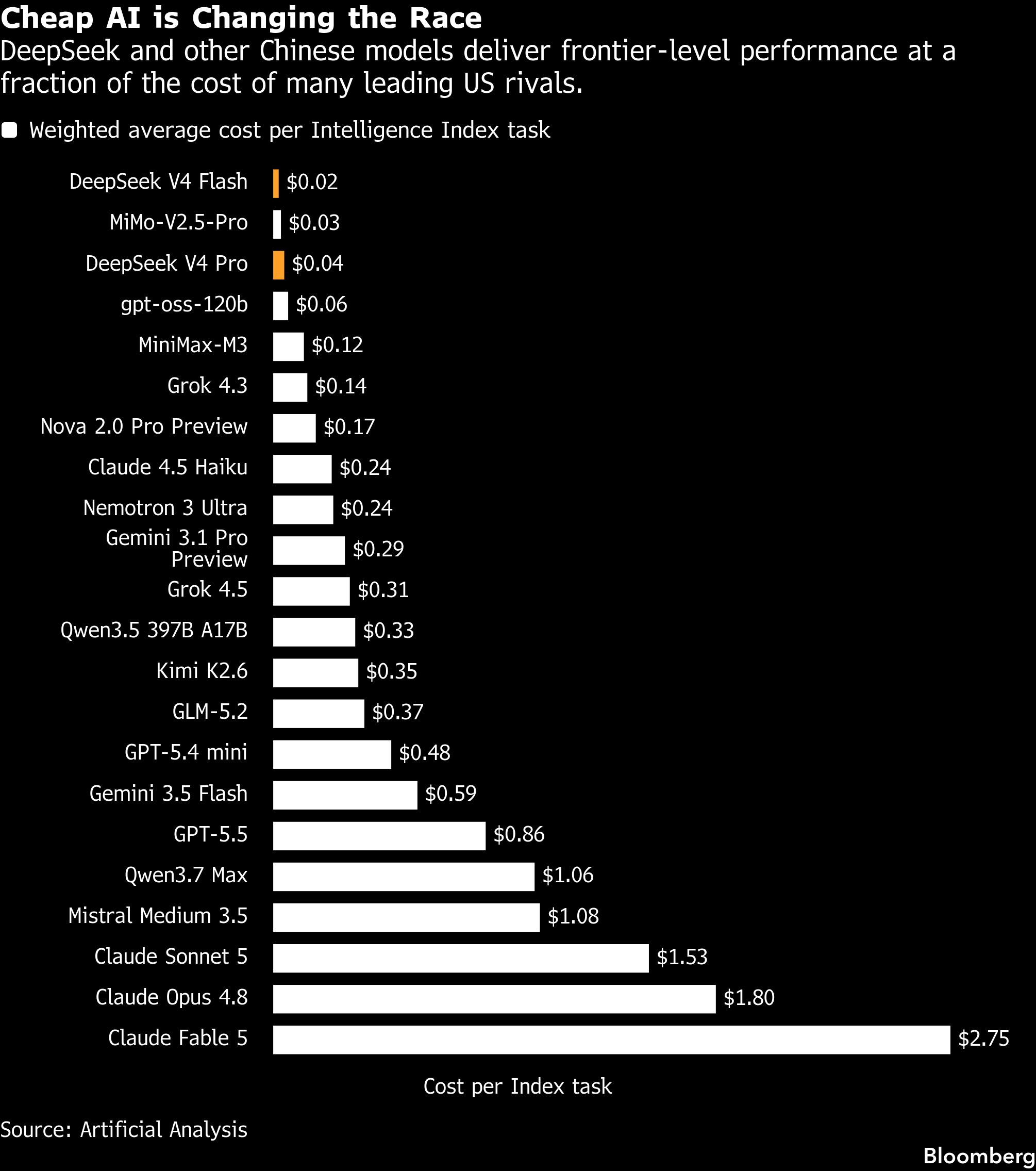
While Trump maintains export controls on the most advanced chips and chipmaking equipment, he’s also been open to selling China semiconductors such as Nvidia Corp.’s H200s, which Beijing has avoided to develop its own sector. So far his administration has refrained from more punitive measures to crack down on chip smuggling in Southeast Asia, and demurred on sanctions or entity-list designations for Chinese companies found to have carried out systematic distillation from US systems. China has continuously narrowed the gap with the US on AI despite the restrictions, as Xi pours money into becoming self-sufficient on the entire tech stack. Although China remains behind on chip production, AI models from companies like DeepSeek and Moonshot have reduced the gap with US frontier offerings in capability, often at a fraction of the cost – threatening to pull away market share from Silicon Valley giants Anthropic and OpenAI. US lawmakers are also considering measures aimed at penalizing Chinese companies found to be copying unfairly from their American counterparts.
In his 3,800-word missive titled “We Must Pace the Frontier,” Amodei called on policymakers to avoid selling China advanced AI chips, crack down on chip smuggling and prevent “unauthorized distillation by companies in authoritarian countries,” among other steps. He urged democracies to maintain a lead “as large as possible,” echoing language from the Biden administration.
A harder loophole to close is Beijing’s ability to remotely rent America’s best semiconductors at Southeast Asia cloud data centers – especially after Trump alienated many of those countries with last year’s trade war.
Those issues will be on display when US and Chinese officials sit down for AI talks planned around the Sept. 24 summit between Xi and Trump.
AI is also likely to feature prominently in leader talks next week, according to a senior White House official, who said Trump had been in touch with some CEOs to gauge their views on the recent controversy over AI safety.
“But leaders and senior policymakers on both sides have to see AI in the context of every other issue they have to contend with, from the war in Iran to rare earths. Things could escalate further. A bipartisan bill is currently pending in Congress, with an aim to curb China’s remote access to Nvidia chips via cloud computing. The Commerce Department’s Bureau of Industry and Security, which oversees chip export curbs, is also scrutinizing the loophole.
“Both countries see AI as one of, if not the most important arena of strategic competition,” said Daniel Remler, a senior fellow at the Center for a New American Security who led AI policy at the State Department under the Biden administration and took part in the first US-China AI dialogue two years ago. “It would involve some degree of monitoring for data centers across multiple countries, particularly in Southeast Asia as well as Japan,” said Chan at Brookings. “As with any effort to restrict China’s access to advanced AI chips, it will be a matter of degrees and effort, not a black-and-white solution.”
